











A new study of cinema markets across the CIS, published in Russia, highlights a trend that has been visible in individual national markets for several years: the common post-Soviet theatrical market is gradually becoming more fragmented, local film industries are growing, and Russian cinema can no longer rely only on the Russian language, cultural familiarity and long-established distribution networks.
According to research commissioned by Moscow International Film Week, CIS countries accounted for more than half of the total international box office of Russian films in the first half of 2026. In 2023, the region’s share was around 15%.
At first glance, this may look like Russian cinema is strengthening its position in the CIS. The picture, however, is more complicated. The growing share of CIS markets is linked not only to the performance of Russian films in the region, but also to shrinking opportunities in other international territories. Outside the CIS, the overseas box office of Russian films fell from $17.6 million in 2023 to $16.6 million in 2024 and around $9.7 million in 2025.
At the same time, Russian films are losing the exceptional position they once held within CIS markets. In 2025, not a single Russian film made the top 50 highest-grossing releases across CIS countries outside Russia.
The most successful Russian film in the region was Gorynych, which earned around 34.5 million rubles and was not released theatrically in Armenia. In Russia itself, the film earned around 1.5 billion rubles. The gap shows how differently the same film can perform in its domestic market and abroad.
Kazakhstan is an especially important example. It is the largest theatrical market in the CIS after Russia and accounted for more than 60% of the total box office of CIS countries outside Russia in 2025, worth around 8.5 billion rubles.
Because of its size and commercial potential, Kazakhstan remains one of the most important markets in the region for Russian films. Yet the structure of the market is changing quickly even there. Kazakh films now account for around 40–45% of the country’s theatrical box office and compete not only with Russian titles but also with Hollywood releases.
Kazakhstan’s local production is also no longer limited to a handful of commercial comedies. Crime dramas, action films, melodramas, science fiction and disaster films are reaching cinemas. A full national slate is gradually taking shape, offering audiences a wider range of genres without the same level of dependence on imported content.
A similar process is taking place in Kyrgyzstan. Between 2022 and 2025, the country’s theatrical box office almost quadrupled, while admissions more than doubled. Local films are appearing more frequently among the market’s biggest hits.
At the same time, there is movement in the opposite direction. Films from CIS countries are beginning to find audiences in Russia. The Kyrgyz film Heaven Is Beneath Mother’s Feet earned around 85 million rubles in Russia, while its sequel passed the 200 million ruble mark.
This is an important shift because the regional film market was previously built largely around a one-way model: Russia produced and exported content, while neighboring markets mainly received Russian-language films. That relationship is now becoming more balanced.
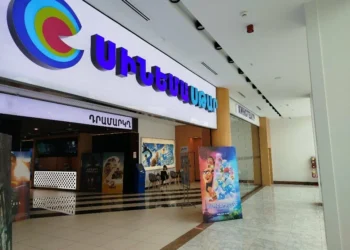
Armenia also fits this trend. According to a KinoPress analysis based on Comscore data, local productions accounted for at least 54.71% of all theatrical screenings in Armenia in 2025.
The highest-grossing film of the year was the Armenian production Vazgen: The Last Sparapet, with AMD 422 million at the box office. Armenian titles also made up most of the year’s top five films.
The trend became even more visible in the first half of 2026. Armenia’s total theatrical box office grew by 34.9% year on year to AMD 2.13 billion, even though the number of new releases fell from 95 to 67.
The top four positions were occupied by Armenian films: Full House: Landing, Try Again, Umbrella and 13 Kilometers from the Tunnel. The first international film appeared only in fifth place.
In other words, the Armenian theatrical market is not growing at the expense of local cinema. On the contrary, domestic production has become one of the main drivers of that growth.
The other side of this trend can be seen in the performance of major Russian releases in Armenia. On January 1, 2026, three family films that earned billions of rubles in Russia had modest opening results in the Armenian market.
Cheburashka 2 earned around AMD 585,000 on its first day, Buratino around AMD 128,000, and Prostokvashino only AMD 21,400. On the same day, Avatar: Fire and Ash earned around AMD 1.52 million in Armenia.
The comparison shows that a highly recognizable brand in the Russian market does not automatically retain the same commercial value in another country.
Language is another factor shaping the market. In the past, having a Russian-language version was often enough to release the same film in several countries across the region with almost no additional adaptation. Today, national markets are placing greater emphasis on localization.
Under Kazakhstan’s law on cinematography, if a film is not screened in Kazakh, it must have Kazakh dubbing, subtitles or voice-over translation. This means that even a completed Russian-language film may require additional spending before entering the Kazakh market.
Armenia has a different legal framework. Full mandatory Armenian dubbing or subtitling of foreign-language films is scheduled to take effect in 2030, although the use of Armenian localization is already gradually expanding in practice.
For a major Hollywood release, the cost of creating one additional subtitle version is almost negligible compared with the overall budget. For a medium-sized or smaller Russian film that may play in only a few cinemas in a particular country, the calculation is different.
The distributor has to pay for subtitles, technical preparation, local promotional materials and marketing. If expected box office returns are low, even these basic costs may be difficult to recover.
For this reason, it is becoming increasingly difficult to view the CIS as a single theatrical market. It is better understood as a group of separate national markets, each with its own language, laws, audience preferences, local production and distribution system.
There is also an interesting feature of Russian industry language: the commonly used phrase “Russia and the CIS,” which seems to place Russia outside the region itself. From a commercial point of view, the distinction is understandable, as the domestic Russian market is separated from export territories. Institutionally, however, Russia itself is a CIS participating state.
The same issue can be seen in the international film business. Under the territorial classification used by the Independent Film & Television Alliance, the CIS includes Armenia, Azerbaijan, Belarus, Kazakhstan, Kyrgyzstan, Moldova, Russia, Tajikistan, Turkmenistan and Uzbekistan.
This is not a political or legal definition of membership. It is a territorial classification used for the licensing and sale of rights to films and other audiovisual works. Still, it shows that in the international film business Russia can be treated as part of the CIS territory itself.
The phrase “Russia and the CIS,” therefore, reflects the old Russia-centered structure of the market more than it literally describes the region. And that structure is now changing.
If Russia was once seen as the natural center of production, language and distribution across the region, Kazakhstan, Armenia, Kyrgyzstan and other countries are now building stronger film ecosystems of their own.
Russian cinema is not disappearing from CIS markets. It still has linguistic, cultural and historical advantages, but those advantages are no longer enough.
For a Russian film, Yerevan, Almaty or Bishkek increasingly look less like extensions of the domestic market and more like genuine foreign territories where distributors need to understand local audiences, localize content, invest in marketing and compete not only with Hollywood but also with local cinema.
This may be the most important conclusion of the new Russian study: across the CIS, the main competitor for Russian cinema is increasingly becoming the national cinema of the very countries that were long seen as a natural market for Russian content.